Showing posts with label crochet. Show all posts

Thursday, February 23, 2012

Griddle Stitch Beanie - Free Crochet Pattern

Recently added to the Handcrafting with Love website, the Griddle Stitch Beanie is quick to make. This free pattern is available in 2 sizes. The stitch pattern creates an interesting texture and the hat is designed to fit snugly for maximum warmth.

Two and a half to 3 ounces of worsted weight yarn makes a hat. Make a solid color hat or add stripes for a great way to add interest and use small amounts of leftover yarn. The Griddle Stitch Beanie is a great project for a quick gift or to donate to charity.

Wednesday, August 17, 2011

Evolution of an Afghan

6 granny rectangles

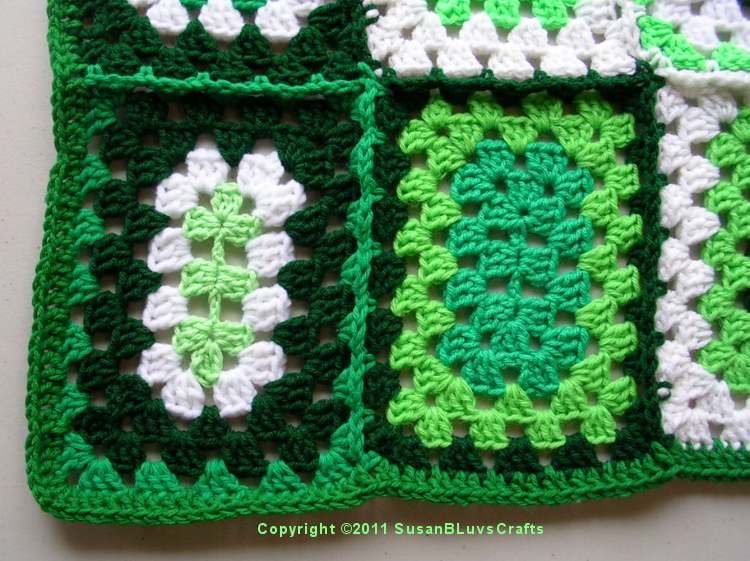
In October 2003, I made half a dozen rectangular granny squares to demonstrate a join as you go technique at a Project Linus event. I used some random bits of yarn that had been donated, including a neon green and some white.

There was only enough yarn for a few rectangles. It was just a sample for a demonstration. I never intended to make it into something usable. But I really hate to throw things away, so those half dozen rectangles sat around with the tiny bits of yarn that were left.

Occasionally more bright green yarn came my way and I added it to the bag. Over the years, I collected enough green yarn to make a whole afghan. The project went on my UFO list in 2008 (the first year I made a list).

Early this year, I got the project out and made the first 3 or 4 rounds of the rest of the granny rectangles. I used a color for 1 or 2 rounds and then changed colors. I made an assortment of different colored centers and then varied the colors in the additional rounds, so few rectangles are alike.

By March 23, I was ready to start joining rectangles. I swept the floor and laid everything out to arrange the blocks. I wrote color names on slips of paper and put those on the blocks to indicate which yarn to make the last round or 2 rounds of the rectangle with.

granny rectangles - 14 joined

14 blocks joined.

granny rectangles - 23 joined

23 blocks joined. Watch closely, the blocks may move to a new position.

granny rectangles - 36 joined

All 36 blocks joined.

Edging - Try 1

granny rectangle edging #1

I merrily started edging the afghan. I made 3 double crochet clusters in the spaces between the clusters on the last round of the rectangles. Then I changed colors and did the same thing in the spaces on the first round of edging.

I decided I didn't like it. The first round of the edging was blending into the blocks and it just seemed like more of the same, rather than a finish.

So I frogged all of the edging and started over.

Edging - Try 2

2 rounds of afghan edging

I made a double crochet in each stitch around this time. A bit more time consuming than making clusters in spaces. The solid, filled in texture clearly distinguishes the edging versus the blocks. I'm satisfied.

I continue until I have 3 rounds of edging complete. Weave in the last of the yarn ends and the afghan is complete.

The afghan was donated to Project Linus in April.

granny rectangle afghan

Saturday, August 06, 2011

Yarn Bowl

A yarn bowl is not a sporting event, though it could tempt pets or small children to play. My (step)sister, Susie, recently gave me this yarn bowl for my 55th birthday. I love the fun purple dots and the purple interior.

yarn bowl

The bowl holds yarn balls and keeps them from rolling away. I love the curvy J-shaped slot that holds your yarn, yet lets you remove it from the bowl if needed. You can also thread yarn through the hole on the right of the slot.

Mom told me that Susie ordered this gem from Nancy's Notions. Nancy has a choice of 2 sizes of yarn bowls in 2 different colors. Put "yarn bowl" into your favorite search engine and you'll find other varies and sources.

Sunday, August 17, 2008

Review: The Crochet Bible

Do you know the crochet basics and want to try something more complex? Want to learn how to finish your work? The Crochet Bible: The Complete Handbook for Creative Crochet by Sue Whiting is a great handbook for learning how to make your project look handcrafted instead of homemade. Whether you want to use more complex patterns or create your own design, The Crochet Bible is a good resource.

The Crochet Bible was first published in the United Kingdom and then "Americanized" and published in the US. I think the Americanization is slightly incomplete in a couple of spots. If you aren’t familiar with the differences in UK vs. US crochet terms, Crochet 'N' More has a Stitch Conversion Chart. The one glaring translation failure is the terms "relief front" and "relief back" stitches. In the US, we call these "front post" and "back post" stitches.

After a brief introduction to hooks, other equipment and yarn types, The Crochet Bible is split into 3 sections: Techniques, Stitch Library, and Projects. I found the 72 page technique section the most useful and informative. The stitch library has 36 stitch patterns in 18 pages, including 6 edging and 4 motif patterns. This is a basic sampling of the many, many possible stitch patterns. The projects (patterns) are a practical application of many of the techniques presented. The stitch library and the patterns describe the stitch pattern in words/abbreviations and illustrate it in symbols.

The techniques section begins with an overview of basic stitches (by the way, there are other acceptable ways to hold the yarn and hook). "Crochet craft" sidebars give added details and insight on the technique being discussed. Technique topics include:

  • Placing the crochet stitches – both or one loop of previous stitch, between stitches, etc.
  • Making crochet fabric – working in rows and rounds
  • Gauge – why and how to make and measure a gauge swatch, including fancy stitch patterns, motifs, and circular patterns
  • Combination stitches – shells, clusters, bobbles, puff stitches, popcorns
  • Relief (a.k.a. post) stitches
  • Picots, bullion stitches and clones knots
  • Linked and crossed stitches, fur stitch, solomon’s knot
  • Branched stitches – make an X, Y or upside down Y
  • Joining new yarn and changing colors - I especially liked the discussion and illustrations explaining why you use the new color of yarn to complete the last stitch in the old color
  • Multicolored designs
  • Shaping – increases and decreases (4½ pages)
  • Following a pattern
  • Filet crochet
  • Seams (3 pages)
  • Making and joining motifs
  • Borders and edgings (5 pages)
  • Decorative details – extra crocheted embellishments, working with beads, embroidery
  • Tartan effects – create plaid fabric
  • Fringes, tassels and pompoms

The patterns in the Projects section give a generic description of the yarn used (number of balls, ball weight, fiber). Yarn details, including brand name and yardage, are given in an appendix immediately after the last pattern. The patterns include:

  • A bunny in 4 sizes
  • Striped, ruffled, and lacy baby clothes and accessories
  • Child’s coat
  • Corsage
  • Scarves
  • Multicolor bag
  • Solomon’s knot wrap
  • Hat and mittens featuring circular motifs
  • Hat, bag, and belt set in mercerized cotton
  • 2 tops, a cardigan and a jacket
  • Pullover sweater in child and adult sizes
  • A fluffy, heart shaped rug
  • A baby blanket and a throw, both in multiple colors
  • Textured pillow covers
  • Heirloom bedspread, an exquisite challenging project

This is not a beginner book, but a crocheter with at least a little experience will find something of interest in the techniques and possibly the patterns. If you’re looking to expand your crochet skills, check it out. If you want a wide variety of crochet stitch patterns, look elsewhere.

Wednesday, January 30, 2008

Review: One-Skein Wonders

Do you have orphaned skeins of yarn in your stash that you want to use? Yarn left after finishing a project or single skeins that you just had to buy? One-Skein Wonders: 101 Yarn-Shop Favorites edited by Judith Durant has a variety of knitting patterns and a few crochet patterns that can be made from a single skein of yarn.

The patterns are organized by type of yarn: bulky-weight, heavy worsted, worsted mohair, worsted-weight, fingering-weight and novelty yarn. Hats, scarves, bags, socks, shawls, and more. With 101 patterns, there is guaranteed to be something you’ll like. The patterns were submitted by yarn shops across the United States.

The monochromatic pictures on the pattern pages obscure project details. The color photo gallery in the center of the book has much better pictures. The photo gallery is not organized by yarn type, making it harder to find a pattern for a specific yarn type. Grouping the glossy color pages and using non-glossy paper and 2 ink colors reduces printing costs, allowing many more patterns for the same price, a nice benefit for the inconvenience.

There is a website for the book, oneskeinwonders.com. The project gallery has color pictures of all the projects in the same order as the patterns in the book. A few sample patterns on the site.

Be sure to visit the One-Skein Wonders page on the publishers website and get the pattern corrections.

Sunday, September 02, 2007

Review: 200 Stitch Patterns for Baby Blankets

200 Stitch Patterns for Baby Blankets by Jan Eaton contains a variety of knit and crochet designs for afghans and shawls. Promoted as designs for babies, the stitch patterns are equally appropriate for older children and adults.

The 200 stitch patterns are divided almost equally between knit and crochet designs. There are instructions for blocks, edgings and all-over stitch patterns. The designs are clearly labeled as knit or crochet and are rated as easy, some experience needed and challenging. The method of working the design, e.g., rows, rounds, diagonal rows, is also shown.

Many of the all-over designs can be knit or crocheted as a block and combined with other blocks. Some block patterns, worked in rows, could be used to create a one piece afghan. For example, filet crochet block patterns could be combined and crocheted as a one piece afghan. You are limited only by your imagination.

A 14 page Techniques section provides a short overview of the basic stitches, then gives more detail on slightly advanced techniques. Several methods are shown for joining blocks.

I had 2 disappointments with this book. One - at least 3 knit patterns were made in different color combinations, with each color combination named and numbered as a unique stitch pattern. I don't think color should count as part of what makes a stitch pattern unique. The stitches are still the same.

My second disappointment is the edging patterns are intended to be knit or crocheted separately from the blanket and then attached. The techniques section shows working a single crochet edging directly into the edge of the blanket, but says to make any of the edging patterns in the book separately and then attach to the blanket.

If you're ready to design your own afghans and need some inspiration to get started, "200 Stitch Patterns for Baby Blankets" may be a book for you.

Monday, September 25, 2006

Review: The Crochet Answer Book

The Crochet Answer Book, by Edie Eckman, uses a question and answer format to present a lot of information in a compact size. Subtitled "Solutions to Every Problem You'll Ever Face; Answers to Every Question You'll Ever Ask", the book includes many of the crochet questions you are likely to have. A beginning or intermediate crocheter will find much helpful information.

The book is divided into 11 chapters including: hooks and other tools, a good yarn, strong foundations, in stitches, tense about gauge, going in circles, a whole cloth, pattern language, on the edge, the finish line and something different. A resources section in the back of the book gives suggestions on finding other crocheters and crocheting resources and has a few useful, informative websites.

"The Crochet Answer Book" is 4½ by 6½ by 1 inch thick, a nice size to carry with your crochet. If you have no crochet experience, you may want to get or borrow a book or video with basic how-to-crochet instructions. The stitch diagrams and instructions in "The Crochet Answer Book" are as good as those in most pattern books, so if you learn easily from books they may be all you need. Once you've made that first scarf or dishcloth, this book can answer your questions and help you learn the finer points of crochet.

This book has good information on marking stitches, finishing your work, how many increases you need to make a flat circle or square, and more. There is detailed information on reading patterns, covering both abbreviations and stitch diagrams.

There is such a variety of crochet stitches and stitch patterns, it is impossible to give detailed information on all aspects of crochet in a book this size. A few of the answers were disappointing. For example, in discussion Tunisian crochet (afghan stitch), the question: "Can I work stitch patterns in Tunisian crochet?" is asked. The answer: "Absolutely!" plus two high level sentences summarizing some of the things you can do. No specific instructions, illustrations or even a suggestion to get a book on Tunisian crochet. If you're going to present the question "Can I ABC?", the answer should say a bit more than "yes" and give some useful details on how to do ABC.

Thursday, August 31, 2006

Review: Stitch 'n Bitch Crochet: The Happy Hooker

Stitch 'n Bitch Crochet: The Happy Hooker is both a learn to crochet book and a collection of interesting crochet patterns. The first 90 pages of the book are dedicated to the basics of crochet with clear diagrams and detailed instructions on exactly where to put the tip of the crochet hook.

The 40 patterns are divided into the categories:

  • Scarves and Shawls, 5 patterns
  • Hats, 6 patterns
  • Bags, 5 patterns
  • Spring & Summer, 6 patterns including a tank top, a shrug and a bikini
  • Fall & Winter, 6 patterns including jackets, sweaters and a skirt
  • Accessories, 5 patterns including Fluffy Bunny Slippers and fingerless gloves
  • Home, Gifts & Baby, 7 patterns, including stuffed animals, an Ipod holder with either a monkey or kitty face, and afghans. One of the afghans has a sock monkey face and matching baby hat.

There is a paragraph to introduce each pattern and information about each of the designers, usually including a website address where you can find more patterns.

There are a variety of patterns in this book and the accompanying text is a fun read. Check it out and see if there is anything you like. I have already made the Yeehaw Lady hat. The cowgirl in this city girl just couldn't resist. My sister asked for the Fluffy Bunny Slippers for her birthday, so they're next on my list. There are a few mistakes in the book. There is a set of corrections you should check before starting any of the patterns.

Friday, July 14, 2006

Review: The Michaels Book of Needlecrafts

The Michaels Book of Needlecrafts has knitting, crochet and embroidery projects. Edited by Dawn Cusick and Megan Kirby and published by Lark Books, this 300+ page hardback book is almost equally divided between the 3 needlecrafts.

Each of the 3 book sections has a list of suggested tools, instructions for the stitches with nice large illustrations and other useful information. The skill level and finished measurements are given for each knit and crochet pattern. The knit and crochet patterns use yarns that are available at Michaels Arts and Craft stores and other chain stores. The knitting section has a page on substituting yarn and the crochet section has a table describing the common weights (by name, not number) with common hook sizes used for each type. It would have been helpful if they had included the yarn weight for those that want to use a different yarn.

The knitting projects include 2 afghans, tops, sweaters, socks, mittens, scarves, hats, purses, a dog sweater and collar, an Ipod holder and wire and bead jewelry. The crochet projects include tops, sweaters, hats, scarves, ponchos, shawls, baby clothes, baby afghans, and purses. The yarns used include cotton, chenille, fuzzy eyelash yarn, mohair, ribbon, microfiber and some more basic yarns.

Most of the embroidery designs are applied to purchased items such as clothing and purses. There are a couple of scrapbook and embroidered card projects. The embroidery techniques include beading, hardanger, and ribbon embroidery.

If you like to knit or crochet with some of the current yarns you will enjoy the projects in this book. If you are a fan of basic acrylic worsted weight yarn, you'll want to look elsewhere. If you like to embroider you may find a design you can't resist in this book.

Wednesday, July 05, 2006

Review: Crochet from the Heart

Looking for some easy crochet projects to make for charity or gifts? Crochet from the Heart: Quick Project for Generous Giving by Kristin Spurkland may have just what you're looking for. The book contains 18 projects, including afghans, hats in sizes for infants through adults, scarves, booties, footies, finger puppets and more.

For those relatively new to crochet or who just need a reminder, there are 15 pages of basic how to crochet and finishing information. Many of the patterns list a specfic brand of yarn, but they all give the yarn weight in the new numbered system. E.g., "3" is light, DK or light worsted weight. This is very helpful in identifying appropriate yarn for a project.

All of the patterns give finished sizes for the project. I especially like this for the hats and other clothing items. I did notice that the hat dimensions vary depending on the stitch pattern. Stretchier hats finish smaller than less stretchy ones. I'm going to make some notes to help me the next time I start designing.

The instructions are clearly written. On the multi-sized clothing patterns it would be good to mark the specific instructions for the size you are making before you start crocheting to make the pattern easier to follow. This is a good book for new crocheters and those looking for an easy project.